Key takeaways
- Rent items that are expensive to buy, used now and then, and quick to check on return.
- Before you buy stock, work out how many paid days each item needs to cover what it cost.
- Licenses, sales tax on rentals and insurance depend on your state and city, so check locally.
- Write rules for deposits, damage, turnaround and late returns before the first booking.
- Take bookings online with availability by date and unit, so nothing gets double booked.
Starting a rental business comes down to four jobs: choosing items people need for a short time but don't want to own, pricing each one so it pays for itself, sorting out the legal basics (registration, sales tax and insurance), and taking bookings that keep track of dates, deposits and returns. This guide covers how to start a rental business in that order, with the costs and the weekly work spelled out, so you can decide whether it suits you before you spend money on stock.
You can start small, even from home, with a handful of items in one category, and grow from what customers ask for.
Choose what to rent
Rent out things that cost a lot to buy, get used for a day or a weekend, and come back in a state you can check in a few minutes. Those traits matter more than any trend.
Run each item you're considering through a quick test:
- Would most people use it only a few times a year? A tile saw, a large frame tent or a cinema lens fits. A kettle doesn't.
- Does buying it hurt? If the purchase price is close to the price of a few rentals, people simply buy.
- Can it take repeated use? Commercial grade gear costs more, but it's built for many users instead of one owner.
- Can you check it quickly on return? Items with few parts, visible wear or a serial number are easier to inspect and to settle disputes over.
- Can you store and move it? Bulky gear needs a garage, a van or a trailer, and that cost lands on day one.
The best items to rent out are often the ones people near you already ask to borrow. Look at what gets requested in local groups, what event planners and contractors in your area hire, and what sells out on weekends at existing rental shops. For a longer list with the trade-offs of each, see rental business ideas.
Work out what each item has to earn
Before you buy stock, work out how many paid rental days each item needs to cover what it cost you, then add what every booking costs to run. If that number of days isn't realistic within a season or two, pick another item or a cheaper source.
Do it per item:
- Payback days. Divide what the item cost you by its day rate. That's how many paid days it needs before it has paid for itself.
- Cost per booking. Add cleaning, consumables, card fees, your time for handover and return, and delivery if you offer it.
- Downtime. Count the days it can't earn: in transit, being cleaned or checked, in repair, or out of season.
- Wear. Set money aside for repairs and for replacing the item when it wears out.
Then set rates customers can compare. Most rental shops quote a day rate plus cheaper weekly and monthly rates, so a long rental doesn't cost the same as seven separate days. Check what shops near you charge for the same item, and stay close to the going rate until you know your own demand.
What it costs before the first booking
Be honest with yourself about the money that goes out before anything comes in:
- Inventory, usually the biggest cost, and the one to keep small until demand is proven.
- Storage that's dry and secure, plus shelving, cases or bags.
- Transport if you deliver: a vehicle or trailer, straps and fuel.
- Insurance for liability and for the gear itself (more below).
- Registration, licenses and permits, which vary by state and city.
- A website and payments: a store plan, a booking tool and card fees on every sale.
- Cleaning and repair supplies, which you'll restock every month.
A camera shop and a tent business have almost nothing in common, so a single "average startup cost" won't tell you much. Price your own list with real quotes.
Set up the legal side
Register the business, get any licenses your city or state asks for, find out whether rentals are taxed where you operate, and get insurance before the first item leaves. Each step depends on your location, so check with your local agencies rather than a generic checklist.
- Registration and licenses. The US Small Business Administration puts it plainly: "Requirements and fees vary based on your business activities, location, and government rules." Start with your city or county business office.
- Tax ID. In the US you can get an Employer Identification Number (EIN) directly from the IRS. The IRS says "You never have to pay a fee for an EIN" and warns about websites that charge for one.
- Sales tax on rentals. Some states tax rentals much like sales. Texas, for example, states that "Receipts from the lease of tangible personal property without an operator are taxable," and lets you buy stock held for lease with a resale certificate instead of paying sales tax at purchase. Check your own state, and ask an accountant how deposits and damage fees are treated.
- Insurance. General liability covers claims of injury or property damage linked to your business. Ask about cover for the gear itself while it's in storage, in transit and at a customer's place; insurers often sell this as inland marine or equipment rental cover. The SBA's advice is to "Speak to insurance agents to find out what kinds of coverage makes sense for your business."
None of this is legal or tax advice. Rules change and depend on where you are.
Write your rental rules
Decide your rules before the first booking and show them on every product page: rental length, deposits, damage, turnaround, late returns and cancellations. Clear rules prevent most arguments.
- Minimum and maximum rental length. A one-day booking may not be worth the handover on bulky gear, and a three-month booking ties up a unit you could rent many times.
- Security deposit. Money held against damage or loss and given back on return. A fixed amount suits high-value items; a percentage of the rental with a cap suits cheaper ones.
- Damage. Say what counts as normal wear and what you'll charge for. Some shops offer an optional damage protection fee that covers small accidents up to a limit. It's a fee and a promise you keep yourself, not insurance.
- Turnaround. Leave days between rentals for cleaning, checks and transit, so the next customer gets a working item.
- Late returns and cancellations. Write down what happens and how much notice you need.
- ID and contact details. Decide what you need from a renter before handover.
Take bookings online
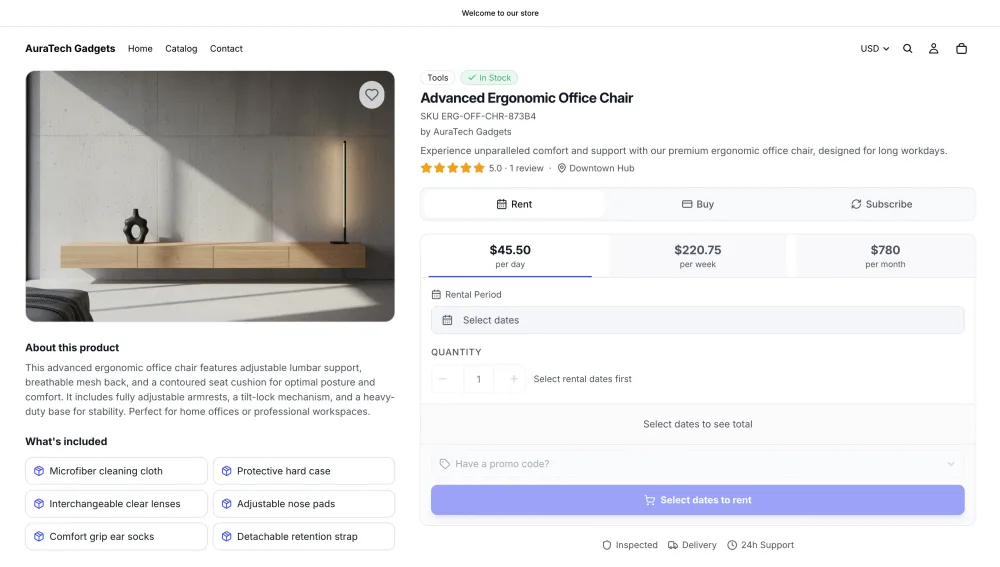
Put each item on a product page with its rates, a calendar that only offers free dates, the deposit and the full total before checkout. A diary and text messages work for the first few bookings; after that, double bookings creep in.
Your booking setup has to handle:
- Availability by date and by unit, so two people can't book the same item for overlapping days.
- Day, week and month pricing worked out for any date range.
- A deposit charged with the rental and returned when the item is back.
- Blocked days for holidays, maintenance and turnaround.
- Reminders before the return date, and a clear list of what's out and what's overdue.
- A quote form for items you can't price up front, such as packages with delivery and setup.
If you sell on Shopify, Rental Suite handles this inside your existing store. It adds a rental date picker and day, week and month rates to the product page, charges a security deposit at checkout and refunds it when you mark the rental returned, and keeps turnaround days clear between bookings. The free plan covers 20 confirmed rental bookings a month, enough to test an idea before you pay for anything. Whatever tool you choose, book an item yourself from product page to return before you announce it.
To see how this works for a gear shop, read equipment rental software.
Run the first month by hand, then fix the gaps
Launch with a few items, do every handover yourself, and write down what goes wrong. The first month teaches you more about pricing, turnaround and damage than any plan.
Track these from the first booking:
- Which items book, and which sit on the shelf.
- How long cleaning and checks really take.
- What comes back damaged or late, and why.
- The questions customers ask before they book. Those answers belong on the product page.
Then adjust: raise rates on what reliably books out, drop what doesn't move, and add more of what people ask for.
What the work looks like week to week
A rental business is a physical business with a website attached. You'll spend more time cleaning, checking, packing and driving than taking orders, and weekends and holidays tend to be the busiest days.
A normal week includes answering questions, confirming bookings, preparing items, handovers or deliveries, returns and inspections, cleaning and repairs, chasing late returns and refunding deposits. Some of it can run on its own (confirmations, reminders, availability). Some can't: a tent still has to dry before it goes back on the shelf. If you start from home, plan where the gear lives, how customers collect it, and whether you'll deliver or offer pickup points.
No guide can tell you what you'll earn. Start with stock you can afford to see sit unused for a while, and grow from real bookings.
Sources (checked 24 November 2026): SBA, Apply for licenses and permits; IRS, Get an employer identification number; 34 Texas Administrative Code § 3.294; SBA, Get business insurance.